
✨ Xishuangbanna: Where the Tropics Meet Ancient TraditionsDai Heartland, Rainforest Magic & Border Charm

Updated: Jul 20
⏱️ Reading time: 12–13 minutes
📍 Location: Southernmost Yunnan | ~540 km southwest of Kunming | Borders Laos & Myanmar, close to Vietnam
🌡️ Climate: Tropical, warm and humid year‑round
📋 In This Guide:
• 🌿 The Land: China’s Only Tropical Paradise
• 🐘 Wild Elephant Valley & The Jungle’s Quiet Heartbeat
• 🌺 Xishuangbanna Tropical Botanical Garden: A World of Plants
• 🎎 Dai Villages: Stilt Homes, Smiles & Slow Days
• ⛪ Temples, Tea Mountains & The Flow of Time
• 🌃 Starlight Night Market: Lights, Flavors & Friendly Faces
• 🏨 Where to Stay: Tropical Comfort & Poolside Relaxation
• 🧭 Our Xishuangbanna Tours & Experiences
• 💡 Practical Travel Tips
♿ Mobility & Accessibility: Comfort for All Ages & Abilities
Xishuangbanna is naturally flat, warm, and well‑developed — making it one of the most accessible tropical destinations in China. We design every journey to be gentle, unrushed, and suitable for seniors, those using wheelchairs, or anyone with limited mobility.
🚶♀️ Getting Around & Transfers
Private transport: We use spacious, air‑conditioned vehicles with easy entry and wide doors, no steps to climb. Transfers are door‑to‑door, with plenty of time to rest and board at your own pace.
Paved paths: All main attractions, parks, and villages have smooth, wide concrete or stone walkways — no steep slopes, rough dirt, or uneven cobblestones.
No high altitude: Jinghong sits at only 550 m, so there is no altitude sickness or shortness of breath — perfect for those with breathing or heart conditions.
🐘 Wild Elephant Valley
Elevated boardwalks: Almost the entire route is on wide, flat, covered walkways with gentle ramps and handrails — no steep climbs.
Electric shuttles: Comfortable, low‑floor buggies take you between zones, cutting walking distance by half.
Rest stops: Shaded benches and seating every 100–200 m, plus accessible restrooms at every major platform.
🌺 Xishuangbanna Tropical Botanical Garden
Accessible circuit: The main routes are fully paved, level, and wide enough for two wheelchairs to pass easily.
Electric sightseeing cars: On‑demand shuttles stop at all key gardens and viewing points — you can see 90 % of the park with minimal walking.
Smooth surfaces: No loose gravel or tree roots; paths are well‑maintained and shaded from the sun.
🎎 Dai Villages & Ancient Towns
Ganlanba & nearby villages: Main lanes are paved and flat, with gentle slopes only. Courtyards and temple grounds are level and wheelchair‑friendly.
Stilt‑home access: We select ground‑level or ramp‑accessible homes for visits, so you can still experience traditional life without climbing stairs.
Wide gateways: Temple entrances and public squares are designed for easy movement.
🚤 River Cruises & Starlight Market
Lancang‑Mekong cruises: Boarding ramps are stable and flat; boats have wide decks, comfortable seating, and accessible restrooms. No balancing or climbing required.
Starlight Night Market: Main thoroughfares are smooth, wide, and well‑lit. We use less‑crowded entry points and avoid narrow side alleys to keep movement easy.
🏨 Accommodation
Pool‑level access: All recommended hotels have ground‑floor rooms or elevators, ramps to pools and restaurants, and wide doorways.
No hills: Resorts are built on flat land, so you won’t need to walk up or down slopes to reach facilities.
💡 Our Approach
We adjust every itinerary to your pace:
Shorter daily distances, more rest breaks
Early‑morning visits to avoid heat and crowds
Pre‑booked tickets and reserved seating
Guides trained to assist with mobility needs
No long hikes, no steep climbs — just calm, comfortable exploration
🌿 The Land: China’s Only Tropical Paradise
Xishuangbanna Dai Autonomous Prefecture sits in the deep south of Yunnan, a long, narrow strip draped along the Lancang‑Mekong River — the same waterway that winds through Myanmar, Laos, Thailand, Cambodia, and Vietnam. This is China’s only true tropical region, where rainforests stretch as far as the eye can see, ancient trees grow hundreds of years old, and temperatures stay comfortably warm even in winter.
Home to 13 ethnic groups, led by the Dai, plus Hani, Lahu, Bulang, Jinuo, and Yao — life here follows a rhythm closer to Southeast Asia than central China. The air is thick, soft, and fragrant; every breath feels like drinking in greenery.
🐘 Wild Elephant Valley & The Jungle’s Quiet Heartbeat
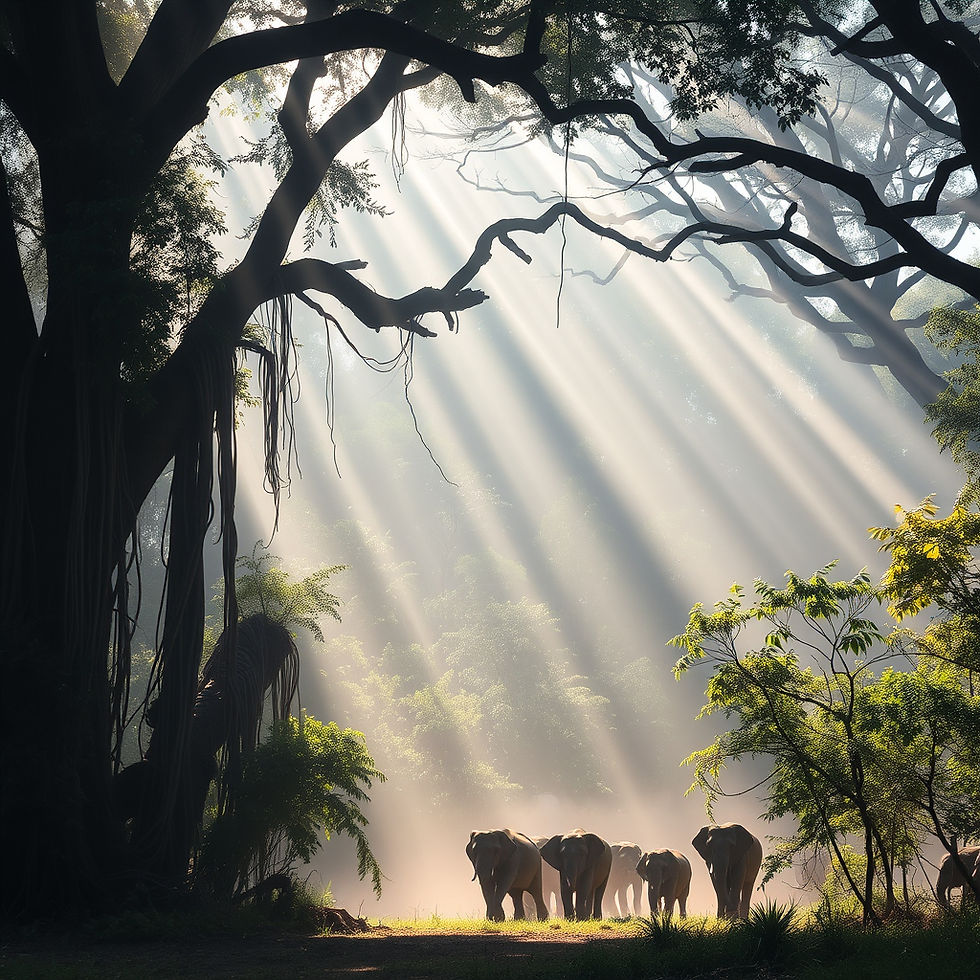
This is where you truly feel the pulse of the tropics. Wild Elephant Valley is not just a park — it is a vast stretch of original rainforest, thick with towering trees, hanging lianas, ferns, and bamboo that grows taller than houses.
When you walk the elevated boardwalks or winding forest trails, you notice the change immediately: the air cools, the light softens to emerald green, and the sounds shift — no traffic, just the rustle of leaves, the call of hornbills, the buzz of insects, and the distant, low rumble of elephants. If you are quiet and lucky, you will spot them: families of Asian elephants moving through clearings, their trunks swinging, calves staying close to their mothers.
Every step brings new discoveries: giant strangler figs wrapping around host trees, wild ginger and turmeric growing along the path, and the earthy scent of damp soil and fallen leaves. There is a deep, calming emotion here — the feeling of being small, safe, and connected to something ancient and vast.
Feeling: Peace, wonder, and a sense of returning to nature.
🌺 Xishuangbanna Tropical Botanical Garden: A World of Plants

This is the magnificent garden you remember — officially Chinese Academy of Sciences Xishuangbanna Tropical Botanical Garden, also called Menglun Garden or Hulu Island. Located 70 km south of Jinghong, it sits on a bend of the Luosuo River, covering 1,100 hectares with over 13,000 plant species across 38 zones.
You walk for hours and never tire:
Giant Water Lilies: Leaves strong enough to hold a small child, floating like green plates
Bamboo Forests: Hundreds of varieties, growing up to 1 meter a day — their rustle sounds like soft rain
Ancient Rainforest Section: 250 hectares of untouched jungle, vines, and trees hundreds of years old
Miracle Fruit: The tiny berry that makes lemons taste sweet for hours after eating
Medicinal & Rare Plants: Used for centuries by locals for healing and daily life
Feeling: Curiosity, calm, and endless fascination — a whole day passes in what feels like minutes.
🎎 Dai Villages: Stilt Homes, Smiles & Slow Days

The best place to experience this is Ganlanba (Dai Garden), a cluster of five original villages: Manchunman, Manting, Manjiang, Manzha, and Manga. Here, time moves at its own pace.
What you see:
Stilted Bamboo Homes: Every house stands 2–3 meters above the ground on thick hardwood posts. The lower level is open, used for storage, animals, and shade; the upper floor is the living space — cool, airy, with woven bamboo walls and slatted floors that let breezes flow through. Around every yard grow coconut, mango, jackfruit, papaya, and banana trees, heavy with fruit.
The Temple at the Center: Every village has its golden‑spired Theravada Buddhist temple, with sweeping tiled roofs and gilded decorations. Monks walk in saffron robes, and locals bring flowers, fruit, and incense for daily offerings.
Daily Life: Under the houses, women sit at wooden looms weaving Dai brocade — bright patterns of elephants, peacocks, and flowers, passed down through generations. Men carve wood or tend rice fields. Children run barefoot, offering sweet smiles and waves. The air smells of jasmine, cooking herbs, and sun‑warmed earth.
How it feels:
You are not just observing — you are welcomed. Locals invite you to sit, share tea, and try pineapple rice or bamboo‑tube rice. There is no rush, no hard sell — just genuine warmth. The feeling is one of gentle belonging, simplicity, and the quiet joy of living close to the land and each other.
⛪ Temples, Tea Mountains & The Flow of Time

Manting Park & Zongfo Temple: The “Royal Garden” of old Dai kings, 1,300 years old. Walk past lotus ponds, frangipani trees, and the main temple where chants and gongs drift through the air — a feeling of deep peace and timelessness.
Menghai Tea Mountains: Rolling hills covered with Pu‑erh tea trees, some over 1,000 years old. You walk through terraced slopes, learn how leaves are picked and sun‑dried, and sit in a tea house sipping rich, earthy brews. Feeling: Grounded, connected to centuries of tradition.
Lancang‑Mekong Cruises: At sunset, the river turns gold. Glide past villages, banana plantations, and distant mountains. Feeling: Serene, expansive, and full of wonder — the same water flows all the way to Vietnam and the South China Sea.
Starlight Night Market: Lights, Flavors & Friendly Faces

The Starlight Night Market in Gaozhuang Xishuangjing is the beating heart of Jinghong after dark. It stretches for kilometers along the river, lit by thousands of paper lanterns, neon signs, and fairy lights, with the grand Golden Pagoda glowing at one end.
What you see:
Food Stalls: Rows of charcoal grills sending up sweet‑smelling smoke. You’ll find grilled river fish wrapped in banana leaves, lemongrass chicken, spicy wild‑mushroom skewers, bamboo‑tube rice, and pineapple rice steamed in the fruit shell. Tables are simple wooden benches, and vendors call out with wide smiles, inviting you to try a bite.
Fruit Stalls: Piles of mangosteen, rambutan, durian, pomelo, and dragon fruit — all fresh, sweet, and incredibly cheap. The sellers peel and slice them right in front of you, handing you a piece with a grin.
Craft & Souvenir Stalls: Hand‑woven silk and cotton, silver jewelry, carved wooden bowls, bamboo hats, and fragrant Pu‑erh tea. Many crafts come from Dai, Hani, and Bulang families, and even across the border from Laos and Myanmar.
The People: Faces are warm and open. Locals wear colorful traditional clothes, tourists laugh while renting Dai silk dresses, and music drifts from small stages — peacock dances, folk songs, and drums. Strangers become friends over a shared plate of food.
How it feels:
Electric, joyful, and utterly alive. The warmth of the people matches the tropical air. It is impossible not to smile, to linger, and to feel like you are part of something vibrant and welcoming. The night passes in a happy blur of tastes, sounds, and laughter.
🏨 Where to Stay: Tropical Comfort & Poolside Relaxation

Xishuangbanna’s best hotels are designed to match the climate and culture — open‑air layouts, lush gardens, and swimming pools to beat the warm afternoons.
Top Choices:
Anantara Xishuangbanna Resort — Right beside the Botanical Garden, surrounded by 150 acres of rainforest. Dai‑Thai style villas, large infinity pool, private terraces, and the scent of frangipani everywhere. Feeling: Luxurious, private, immersed in nature.
Mekong Jinglan / Gaozhuang Hotels — In the heart of Jinghong, steps from the Starlight Market. Rooftop pools overlooking the Lancang River, cool tiled rooms, and lush inner gardens. Feeling: Convenient, lively, yet peaceful.
Rainforest Retreats — Smaller boutique lodges near villages or the jungle. Open‑air lobbies, shaded pools, organic local breakfasts, and the sound of birds waking you in the morning. Feeling: Authentic, quiet, and deeply relaxing.
The experience: After a day of walking through gardens, villages, and markets, you return to cool, fresh rooms and step into the pool — warm water, cool breezes, and the sky turning soft pink. It is the perfect way to end a day, feeling refreshed and at peace.
🧭 Our Xishuangbanna Tours & Experiences
✅ Classic Tropical & Cultural Tour (3–4 days)
Explore Wild Elephant Valley & rainforest trails
Full day visit to Xishuangbanna Tropical Botanical Garden
Wander Ganlanba Dai villages, meet locals, and learn weaving
Cruise the Lancang‑Mekong River at sunset
Evening at Starlight Night Market — eat, browse, soak in the vibe
Stay in pool‑equipped Dai‑style hotels
✅ Nature & Border Adventure (5 days)
Everything in the classic tour
Trek deeper into the rainforest
Visit remote Hani and Bulang mountain villages
Day trip to the Laos border at Mohan
Tea‑making workshop in Menghai
More time to relax poolside
✅ Tailor‑Made Private Tours
Build your itinerary around photography, hiking, food, or pure relaxation
All details handled: Tickets, transport, local guides, pool‑friendly accommodation, and restaurant reservations
No rush, no crowds — travel at your own pace


Comments